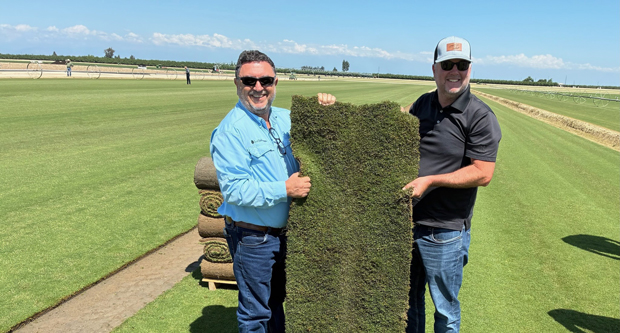

More than 120 experimental bermudagrass selections, including industry standards, entered the Turf Research Bermuda California (TRBC) project, and only one emerged as the final choice. That selection enters the market as HighPoint Bermudagrass.
Its release follows two decades of breeding, research and field evaluation. HighPoint’s story began in 2006 at Oklahoma State University (OSU), where turfgrass breeder Yanqi Wu, Ph.D., and the Department of Plant and Soil Sciences began developing and evaluating new bermudagrass lines that would eventually be tested under a wide range of growing conditions.
In 2016, OSU, A-G Sod Farms and Sod Solutions launched the Turf Research Bermuda California (TRBC) project, a collaborative effort to evaluate more than 100 Bermudagrass selections, including experimental lines from the OSU breeding program and industry-standard varieties, under California growing conditions.
The objective was straightforward but ambitious: identify a bermudagrass capable of thriving in Southern and Central California while delivering traits growers and turf managers value heavily. Over the next decade, researchers and growers narrowed the field to a single selection that could meet the needs of sod producers, sports turf managers, golf course superintendents and landscape professionals.
Researchers sought a variety capable of helping meet California’s evolving water-use demands while providing a viable warm-season alternative for landscapes traditionally planted with tall fescue and Kentucky bluegrass. To achieve that objective, they prioritized improved winter color retention, drought tolerance, dark genetic color, reduced seedhead production and lower vertical growth. Just as importantly, they wanted a grass that could perform consistently across environments and management conditions.
To begin the search, more than 100 Bermudagrass selections, including experimental lines from the OSU breeding program and industry standards, were planted at A-G Sod Farms in Nuevo, Calif.
Over the next several years, researchers, Sod Solutions agronomists and sod farm personnel evaluated each entry under California growing conditions and collected data. By 2019, the field had been narrowed to just 11 lines that advanced to a second phase of testing in Nuevo and Fresno, Calif., where the focus shifted to characteristics critical to both production and performance, including drought tolerance, cold tolerance and sod strength. As testing intensified, the field narrowed and four selections advanced to the final phase. Larger trial plots were established in Nuevo and Selma in 2021, allowing researchers to evaluate key production and performance characteristics while generating enough plant material for future expansion. Winter color evaluations and dry-down testing followed.
Experimental line OKC-09, identified as experimental line 1337 in OSU’s National Turfgrass Evaluation Program (NTEP) trials, consistently delivered strong summer performance, excellent drought recovery and the highest tensile strength among the final candidates. Results remained consistent across both trial locations.
The larger plots also provided an opportunity to evaluate how the selections performed throughout the production cycle, from establishment through post-harvest recovery. Those observations provided valuable insight into the variety’s production potential and generated information future growers can use. According to the final TRBC findings, OKC-09 demonstrated the strongest overall performance among the remaining selections and was ultimately selected for release. That selection would later receive its commercial name: HighPoint Bermudagrass.
For Larry LeMay, president of A-G Sod Farms and current president of Turfgrass Producers International, the selection represented the culmination of more than a decade of evaluation through the TRBC project. Over the course of the program, A-G hosted and evaluated more than 124 experimental and named Bermudagrass selections, narrowing the field to one commercial release.
“To get it down to one that made the grade after 10 or 11 years, it was quite a process,” he explained.

Why HighPoint matters
The bermudagrass market is crowded with proven performers, making meaningful differentiation increasingly difficult, according to Sod Solutions. HighPoint enters that market with a combination of characteristics rarely found together in a single variety.
Developed as a premium, interspecific hybrid, HighPoint represents the next generation of bermudagrass breeding, bringing together improved cold tolerance, drought efficiency, wear tolerance and sod strength in a single variety. The result is a versatile bermudagrass designed for the Transition Zone and other warm-season growing regions.
Its fine leaf texture, dense canopy and rich green genetic color contribute to strong visual quality while maintaining the durability required for high-traffic environments. Low seedhead production helps preserve a cleaner appearance throughout the growing season while reducing one of the common aesthetic challenges associated with bermudagrass.
HighPoint has also demonstrated excellent sod tensile strength, helping improve harvest efficiency while providing durability during transportation and installation. Combined with strong traffic recovery and drought performance, the variety offers a well-rounded option for a wide range of turf applications, according to the company.
“We used nationwide standards, which helped select a grass that could adapt well not only for Southern California, but also for the Transition Zone and beyond,” said Roberto Gurgel, director of research for Sod Solutions.
That broader approach ultimately helped identify a variety capable of performing across a wide range of environments while meeting the needs of both growers and end-users. According to Gurgel, HighPoint’s rapid regrowth and tensile strength further separated it throughout the evaluation process.
From research to real applications
Earlier this year, LeMay hosted a small group of sod producers from across the country for a firsthand look at HighPoint as the variety moves toward broader commercial production. The gathering provided an opportunity to evaluate the grass in the field, discuss production considerations and share perspectives on where it may fit within different markets.
After more than a decade of evaluation, it provided an opportunity to share the variety with producers who may help shape its next chapter. It was also one of the few opportunities in recent years to host a group of sod producers at his farm, something LeMay said made the day especially meaningful.
“You can learn so much by being around other growers,” he said. “To have these top guys out at the farm to see the work we’ve gone through, and have dinner and lunch with them, it was a very special day.”
Sod Solutions stated producers in attendance complimented the operation and were impressed by what they saw from HighPoint in a production setting. Color, density and low seedhead production were among the characteristics that drew the most attention. Growers also noted the variety’s ability to perform under lower mowing heights, highlighting its potential beyond the residential market in golf and sports turf settings.
According to LeMay, HighPoint breeder Wu of OSU conducted extensive cold-tolerance research on the selection, evaluating how it responds to low temperatures and recovers as conditions warm. Those findings, combined with years of field observations in California, have helped fuel interest in HighPoint’s ability to perform beyond traditional Bermudagrass markets.
“It has the ability to not only do well in the Sun Belt states, which most bermudas do well in, but it appears that it has good potential and winter hardiness to go up into and maybe past the Transition Zone,” LeMay said.
Producers are also paying close attention to traits that could help extend seasonal color and reduce the need for overseeding, particularly in areas where winter appearance remains an important consideration. LeMay noted that a nearby California golf course is currently evaluating HighPoint on a tee box as part of that effort. Now, a handful of experienced bermudagrass growers in Colorado, Missouri and Tennessee have purchased plant material for production and evaluation.